Section 1
What slippage is
When you click buy or sell, your order travels to the broker and then to its liquidity providers or its own pricing engine. Prices can move in the fraction of a second that takes. If the price you saw is no longer available, the order is filled at the next available price. The gap between the two is slippage.
Slippage affects every kind of trader, but in different ways. A long-term trader entering a few times a month barely notices a pip here and there, while a scalper aiming for a few pips per trade can see slippage take a large share of the expected profit.
Slippage is measured in pips, just like the spread. On one standard lot of EUR/USD, one pip of slippage is worth $10. It is not a fee the broker charges, but it is a real trading cost because it changes your entry or exit price.
Section 2
Positive vs negative slippage
Negative slippage means you get a worse price than requested: you pay more when buying or receive less when selling. Positive slippage means you get a better price: the market moved in your favour before the fill.
Fair execution policies pass on both. Some brokers describe their slippage handling in their order execution policy, and it is worth reading if execution quality matters to your strategy. Over many trades a balanced execution should show both kinds, not only negative fills.
Section 3
Requested price vs filled price
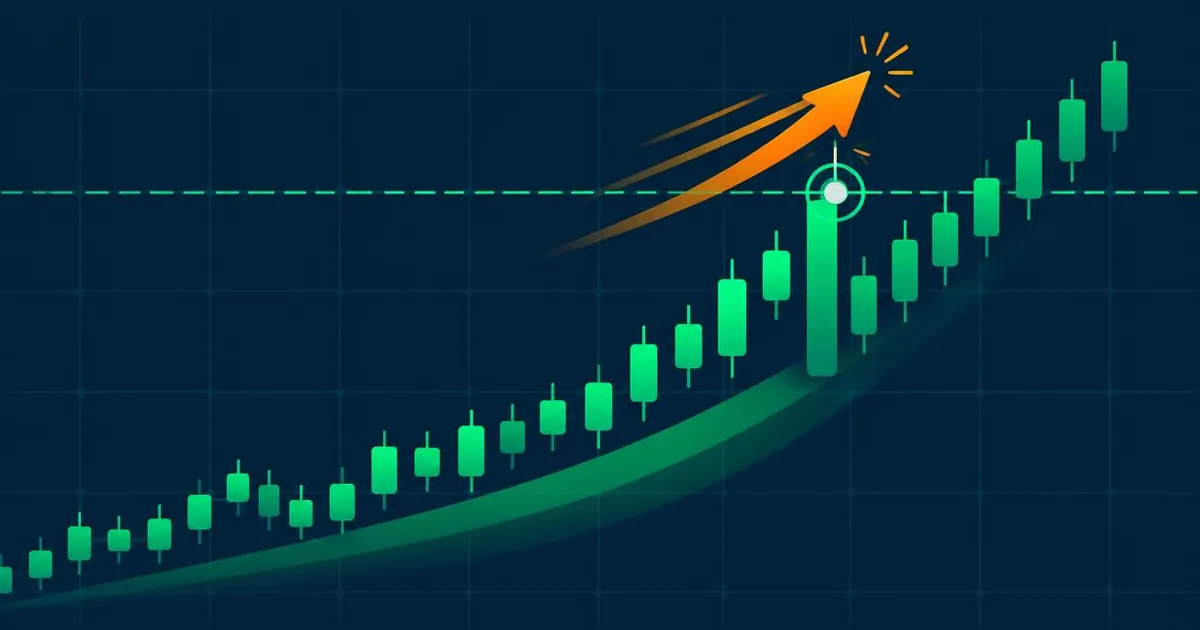
The chart below shows a buy order sent while the price is rising quickly. The trader requests the ask price at the moment of clicking, but by the time the order is executed the ask has moved higher, and the order is filled 2 pips above the requested price.
Section 4
Why slippage happens
Slippage is a sign of fast or thin markets more than of any single broker. The most common causes are:
- News releases: central bank decisions, inflation data and employment reports can move prices many pips in seconds.
- Market gaps: prices can open at a very different level after a weekend or a holiday, skipping every price in between.
- Low liquidity: in quiet sessions, on exotic pairs or around the daily rollover there are fewer prices on offer.
- Market orders: an order to buy or sell "at market" accepts the best available price, whatever it is.
- Large orders: a big position may need to be filled across several price levels.
Section 5
Worked examples
Two short examples show how slippage turns into money. Both use a USD account and EUR/USD, where one pip on a standard lot is $10.
Slippage on entry and on a stop-loss
- Entry: buy 1 lot at market, requested 1.10500, filled 1.10520. Slippage = 2 pips = $20.00 extra cost.
- Stop-loss: long 1 lot with a stop at 1.10000. After a weekend the market opens at 1.09800.
- The stop triggers and fills at 1.09800: 20 pips beyond the stop = $200.00 more loss than planned.
The first example is a small, everyday cost. The second shows why gaps matter: a stop-loss is an instruction to close at the next available price once triggered, not a guarantee of that exact price.
Section 6
Slippage vs a wider spread
Slippage and spread widening often happen at the same moments, but they are different things. The spread is the gap between the bid and ask prices that you can see before you trade. Around news it can widen from a fraction of a pip to several pips, and you pay that wider spread on any trade you open.
Slippage is the gap between the price you saw and the price you got. It comes from the price moving while the order is processed. In a fast market you can face both: a wide spread and a fill a few pips away from your requested price.
To see your own slippage, compare the price on your order with the fill price in your trade history. Doing this over a few dozen trades shows whether slippage is a real cost for your style of trading, and at which times of day it appears.
Section 7
How order types affect slippage
The type of order you use decides whether slippage can happen and in which direction.
Market and stop orders
Market orders and standard stop orders, including stop-losses, become market orders once triggered. They prioritise getting filled over the exact price, so they can slip in either direction.
Limit orders
A limit order fills only at your price or better. A buy limit can fill at or below your price; a sell limit at or above it. The trade-off is that a limit order may not be filled at all if the market moves away. Take-profit orders are usually limit orders.
Guaranteed stop-loss orders
Some brokers offer guaranteed stop-loss orders on some instruments. They close the position at exactly your stop price, even through a gap. Where offered, a guaranteed stop usually carries a premium, often charged only if it is triggered, and may need to be placed a minimum distance from the current price. Check whether your broker offers them and what they cost.
Section 8
How to reduce slippage
You cannot remove slippage completely, but you can limit how often and how much it affects you.
- Avoid placing market orders in the seconds around major news releases.
- Trade liquid pairs during their busiest sessions, such as EUR/USD in the London and New York overlap.
- Use limit orders for entries and take-profits when the exact price matters more than being filled.
- Be aware of weekend gap risk if you hold positions over the weekend, and consider a guaranteed stop where it is offered.
- Split very large orders if your broker's liquidity is limited.
Compare brokers
Compare brokers: execution details in our reviews
We don't hold slippage statistics for brokers. Order types, guaranteed stops and execution details are covered in each broker review; the brokers we currently review are listed below.





Published broker information as stored in our records, not live terms. Confirm current conditions with the broker before you trade.
Key takeaways
- Slippage is the gap between the requested price and the filled price.
- It can be negative or positive; fair execution passes on both.
- It is most likely around news, at market gaps and when liquidity is thin.
- Limit orders never fill at a worse price but may not fill at all.
- A normal stop-loss can slip through a gap; a guaranteed stop, where offered, cannot.
Frequently asked questions
Is slippage a broker fee?
No. Slippage is a change in price between your request and the fill. It is not charged as a fee, but it does affect your trading cost.
Can slippage be positive?
Yes. If the price moves in your favour before your order is filled, you get a better price than requested. That is positive slippage.
Why does my stop-loss fill at a worse price?
Once triggered, a standard stop-loss becomes a market order and fills at the next available price. In a fast market or a gap, that price can be beyond your stop.
Do limit orders have slippage?
A limit order cannot fill at a worse price than you set. It may fill at a better price, or not at all if the market does not reach your level.
What is a guaranteed stop-loss?
A stop-loss that closes your position at exactly the price you set, even through a gap. Some brokers offer it on some instruments, usually for a premium.
When is slippage most likely?
Around major economic news, at the weekly or holiday open, during quiet sessions and on less liquid pairs.
Keep learning
Trading forex and CFDs involves a high risk of losing money. Leverage can work against you.
FXSpreadMeter Education
Written by: FXSpreadMeter Editorial Team
Last reviewed: 21 November 2026
This lesson is general educational information produced in-house. It is not personal advice, not a recommendation, and it has not been reviewed by an external financial adviser. Trading leveraged products carries a high level of risk to your capital.