Section 1
How leverage works
When you trade forex with a broker, you rarely pay the full value of the currency you buy. One standard lot of EUR/USD is 100,000 euros, worth about $110,000 at a price of 1.1000. Very few traders could fund that in cash, so brokers ask for a deposit instead and lend you the exposure.
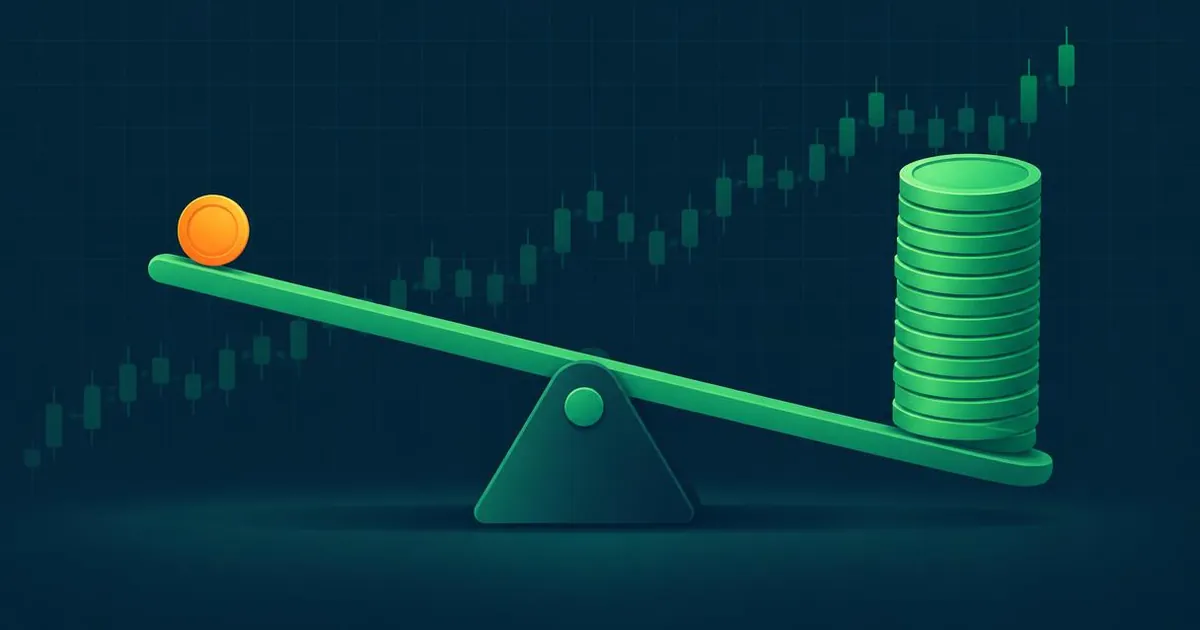
Leverage is the ratio between the size of the position and the deposit needed to hold it. A ratio of 1:30 (also written 30:1) means the position can be up to 30 times your margin. A ratio of 1:100 means up to 100 times, and 1:500 means up to 500 times.
The important point is that leverage changes how much money you need to open a trade, not how much a pip is worth. The profit or loss of a trade depends on the position size and the price move. Leverage simply makes larger positions possible with a smaller account, and that is what makes it powerful and risky at the same time.
Section 2
Common leverage ratios
Leverage is usually shown as a ratio. The percentage next to it is the margin requirement: the share of the position value you must deposit.
- 1:1 — no leverage. You deposit the full value of the position (100% margin).
- 1:30 — you deposit about 3.33% of the position value. A common cap for retail clients on major pairs in several regions.
- 1:100 — you deposit 1% of the position value.
- 1:500 — you deposit 0.2% of the position value.
The ratio a broker advertises is a maximum. Many traders choose to use far less, either by trading smaller positions or by setting a lower leverage on their account where the broker allows it.
Section 3
How leverage magnifies gains and losses
Because the position is larger than your deposit, a small move in the market becomes a large move in your account. The same percentage move produces the same change in the position's value, but relative to the money you put up the effect is multiplied by the leverage you use.
Imagine you use your whole account as margin and EUR/USD moves 0.2%, about 22 pips. Without leverage your account changes by 0.2%. At 1:30 it changes by 6%. At 1:100 it changes by 20%, and at 1:500 a 0.2% move against you would wipe out the whole account. The chart below shows the same price move at different leverage levels.
This works in both directions. Leverage does not make a trade more likely to win; it only makes the result larger. A strategy that loses a little without leverage loses a lot with it.
Section 4
Worked example on EUR/USD
Here is the same trade at three different leverage ratios. The account is $2,000 in US dollars and the trader buys 0.1 lot of EUR/USD (10,000 euros) at 1.1000. The position is worth $11,000.
Same position, different leverage
- Position value: 10,000 × 1.1000 = $11,000.
- Margin at 1:30 = $11,000 ÷ 30 = $366.67. At 1:100 = $110.00. At 1:500 = $22.00.
- Pip value on 0.1 lot = $1.00. A 50-pip move = $50.00 profit or loss at every leverage ratio.
- $50 is 2.5% of the $2,000 account, whatever the leverage ratio.
The trade's result is identical in all three cases. What changes is how much margin is locked up and how much free money is left. With 1:500 the trader could open a position 15 times larger than at 1:30 with the same margin, and a 50-pip move on that larger position would be $750, more than a third of the account. That is the real risk of high leverage: it allows positions that are too big for the account.
Section 5
Effective leverage: the number that matters
Maximum leverage is what the broker allows. Effective leverage is what you actually use: the total value of your open positions divided by your account equity.
In the example above the position is $11,000 and the account is $2,000, so effective leverage is 5.5:1 whether the account is set to 1:30 or 1:500. Many risk-conscious traders keep effective leverage low and size positions by how much they are prepared to lose if the stop-loss is hit, rather than by how much margin is available.
Section 6
Leverage caps by region
Regulators in several regions limit the leverage brokers may offer retail clients. The rules below are summarised in general terms; they apply per regulator and client type, and professional clients may be treated differently.
- European Union (ESMA) and United Kingdom (FCA): retail CFD leverage is capped at 1:30 on major currency pairs, 1:20 on non-major pairs, gold and major indices, 1:10 on other commodities and non-major indices, and 1:5 on individual shares.
- Australia (ASIC): retail CFD caps follow a similar structure, including 1:30 on major currency pairs.
- United States (CFTC and NFA): retail forex leverage is limited to 1:50 on major pairs and 1:20 on other pairs.
- Other regions set their own limits, and some offshore regulators allow much higher leverage.
The same broker group can offer very different leverage depending on which of its regulated entities opens your account. That is why a broker's headline "up to 1:500" may not apply to you. Check which entity you would join before comparing leverage.
Section 7
Using leverage more safely
Leverage is a tool, not a target. A few habits keep it under control.
- Decide your risk per trade first, for example 1% of the account, then size the position from your stop-loss distance.
- Keep an eye on effective leverage across all open positions, not just one trade.
- Leave enough free margin so normal price swings do not trigger a margin call.
- Use a lower account leverage setting if your broker offers one and you do not need more.
Compare brokers
Compare brokers: maximum leverage
Maximum leverage as published by each broker we review, by account and as stated in our broker records. Your own maximum depends on the regulated entity that opens your account.
| Broker | Max leverage by account | Leverage notes | Checked | Visit broker |
|---|---|---|---|---|
 FP Markets | 1:500 / 1:30 | Up to 1:500 (depends on entity; 1:30 for ASIC retail clients) | 2026-11-10 | Visit broker |
 XM Group | 1:1000 | 1:30 for ASIC retail clients; higher under other group entities | 2026-11-10 | Visit broker |
 XTB | 1:500 / 1:30 (ESMA cap) / 1:30 (FCA cap) | 1:30 for FCA and KNF retail clients; higher under other group entities | 2026-11-10 | Visit broker |
 Tickmill | 1:1000 | Up to 1:1000 advertised; UK retail clients typically capped at ~1:30 | 2026-09-04 | Visit broker |
 Pepperstone | 1:200 / 1:30 | 1:30 for FCA and ASIC retail clients; higher under other group entities | 2026-11-10 | Visit broker |
 FxPro | 1:200 | — | 2026-11-10 | Visit broker |
 Fusion Markets | 1:500 | Up to 1:500 | 2026-11-13 | Visit broker |
 NAGA | — | Up to 1:1000 (Seychelles and St Vincent entities), 1:500 (Abu Dhabi entity), 1:30 for EU retail clients | — | Visit broker |
 Tauro Markets | — | — | — | Visit broker |
Published broker information as stored in our records, not live terms. Confirm current conditions with the broker before you trade.
Key takeaways
- Leverage is the ratio of position size to the margin you deposit.
- 1:30 means a 3.33% deposit; 1:100 means 1%; 1:500 means 0.2%.
- Leverage does not change pip value: position size and price move set your profit or loss.
- Higher leverage allows bigger positions, and bigger positions mean bigger losses.
- Retail leverage is capped in many regions, for example 1:30 on major pairs under ESMA and FCA rules.
Frequently asked questions
What does 1:30 leverage mean?
You need $1 of margin for every $30 of position. Opening a $30,000 position requires $1,000 of margin, a 3.33% deposit.
Is higher leverage better?
Not in itself. Higher leverage only lowers the margin needed. It makes oversized positions possible, which is why many regulators cap it for retail clients.
Does leverage change the value of a pip?
No. Pip value depends on the position size and the pair. A 0.1 lot EUR/USD position is worth $1 per pip at 1:30 or 1:500.
What is the maximum leverage for retail traders in the UK and EU?
Under FCA and ESMA rules, retail clients can use up to 1:30 on major currency pairs and lower ratios on other instruments.
Can I lose more than my deposit with leverage?
Losses can exceed the margin on a trade. Whether they can exceed your account balance depends on negative balance protection, which is required for retail clients in some regions.
How do I choose how much leverage to use?
Start from the amount you are willing to lose per trade and your stop-loss distance, then calculate the position size. The leverage you need follows from that.
Keep learning
Trading forex and CFDs involves a high risk of losing money. Leverage can work against you.
FXSpreadMeter Education
Written by: FXSpreadMeter Editorial Team
Last reviewed: 21 November 2026
This lesson is general educational information produced in-house. It is not personal advice, not a recommendation, and it has not been reviewed by an external financial adviser. Trading leveraged products carries a high level of risk to your capital.